
If you have ever opened a Soroban contract on Stellar and stopped at a wall of XDR, you already know the problem Naralabs is trying to solve. Chain data is public, but it is not always legible, and legibility is what turns a protocol into a product people can ship on. Explorers that only show hashes and hex leave the hard work to the reader. We wanted the opposite: a place where events read like events, contracts feel inspectable, and decoding is a first-class feature instead of a weekend script.
Naralabs began as an Instaward build on Stellar: a $5,000 grant with a clear statement of work. Deliver explorer infrastructure that helps developers read, filter, and reason about on-chain activity, plus the registry plumbing to make semantic decoding repeatable. That is a different bar from a hackathon repo. Reviewers expect milestones, evidence, and something still running after the check clears. We treated the grant like a small product engagement: scope, ship, document, and leave repos a stranger can clone.
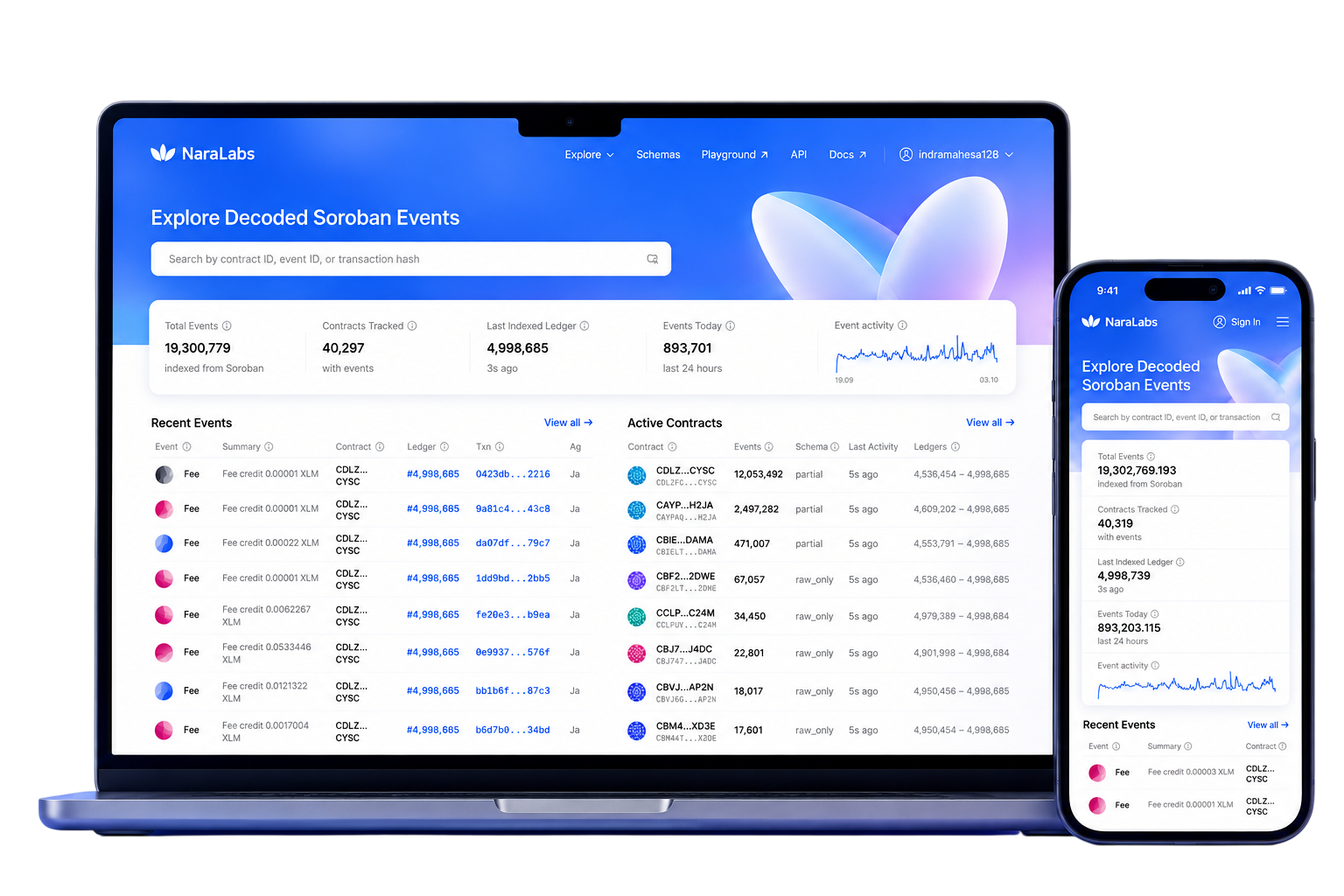
On the frontend, naralabs-web is Next.js 16 with React 19 and Tailwind 4. It acts as the BFF: explorer pages, auth flows, and dashboard pieces like watchlists, tags, notes, and verified addresses. Auth routes proxy to Atlas; session cookies stay HTTP-only. The goal was velocity on UI without cheating on API boundaries, so the web app stays thin where the backend must be authoritative.
Atlas (naralabs-atlas) is the other half of the story: a Go platform that runs the indexer worker and the HTTP API. Ingest polls Stellar RPC, persists raw XDR and structured JSON, and maintains derived tables with a durable cursor. SEP-0048 event schemas live in Postgres; events land in ClickHouse for explore workloads. Semantic decode can run on ingest and on demand via decode endpoints, with replay tooling when registry definitions catch up to history.
That split is intentional. UI teams should not fork indexer logic, and indexer teams should not block on every chart tweak. The org at github.com/naralabsdev mirrors that: naralabs-web, naralabs-atlas, naralabs-cli, and naralabs-perf. Each repo has a job. Together they answer a question Stellar builders keep asking once they leave the tutorial: what happened in my contract, in words I can put in a dashboard?
Instaward forced us to be explicit about outcomes. Scope, timeline, and completion evidence are part of the craft, not bureaucracy. The completion report below is the formal record of that delivery: what we committed to, what we shipped, and how we closed the grant.
Naralabs sits at the intersection I like working in: protocol standards (SEP-0048), data pipelines that have to be correct, and product surfaces that still feel fast. It is grant-funded, open source, and live at naralabs.io. That combination is rarer than it should be, and it is the kind of work I want to keep doing.